
From fan zones to hotel lobbies to arena concourses, LiveX AI deployed human-like AI agents across the biggest sports moments of summer 2026 — and turned everyday venue spaces into measurable guest engagement, sponsored revenue, and loyalty growth.
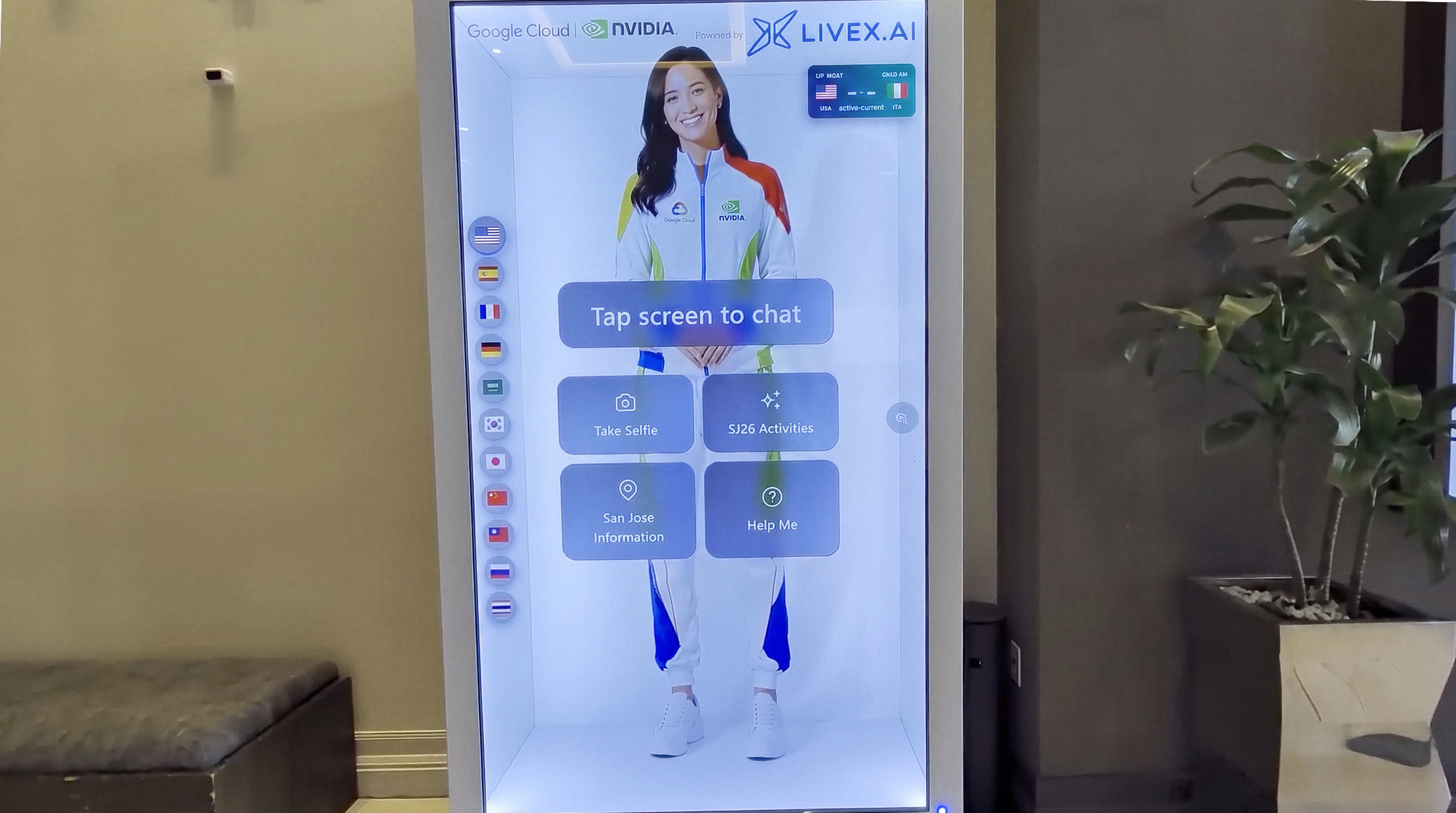
Over one summer, in hotel lobbies and fan zones across the San Francisco Bay Area, World Cup guests from dozens of countries walked up to a life-sized AI avatar, spoke to it in their own language, and walked away with a branded photo they chose to keep.
That moment played out thousands of times across LiveX AI's summer of 2026. Over the two largest sports stages of the season — the World Cup in the Bay Area and NBA Summer League in Las Vegas — LiveX deployed human-like AI agents through holograms, kiosks, and real-world touchpoints. Powered by NVIDIA and Google Cloud, Lyra — LiveX Your Real-world Agent — ran continuously for 39 days across multiple World Cup venues, then simultaneously powered an entirely different experience on the NBA Summer League concourse in Las Vegas.
For most of its short history, "AI in public spaces" has meant a stunt — a novelty screen wheeled into a lobby for a launch week, admired, photographed, and unplugged. Summer 2026 marks the end of that era. The deployments described here were not activations that ended when the event did; they were infrastructure that stayed, generated revenue, and got expanded. That is the real threshold physical AI has crossed: from marketing moment to operating equipment.
What makes that shift possible is easy to miss, because the eye-catching part — a fan laughing with a hologram — is not where the value lives. The value lives in what happens after the conversation: the photo the guest saves, the QR code they scan, the loyalty account they open, the hoodie they buy. Call it the post-interaction layer. A traditional physical experience — a booth, a banner, a photo backdrop — ends when the person walks away. A physical AI interaction is engineered so that walking away is the beginning: it converts a moment of attention into a measurable, ownable action that continues on the guest's own phone, in their own feed, on the venue's own books. Every case that follows is, at bottom, a demonstration of that layer at work.
World Cup Festivities: 39 Days Across the Bay Area
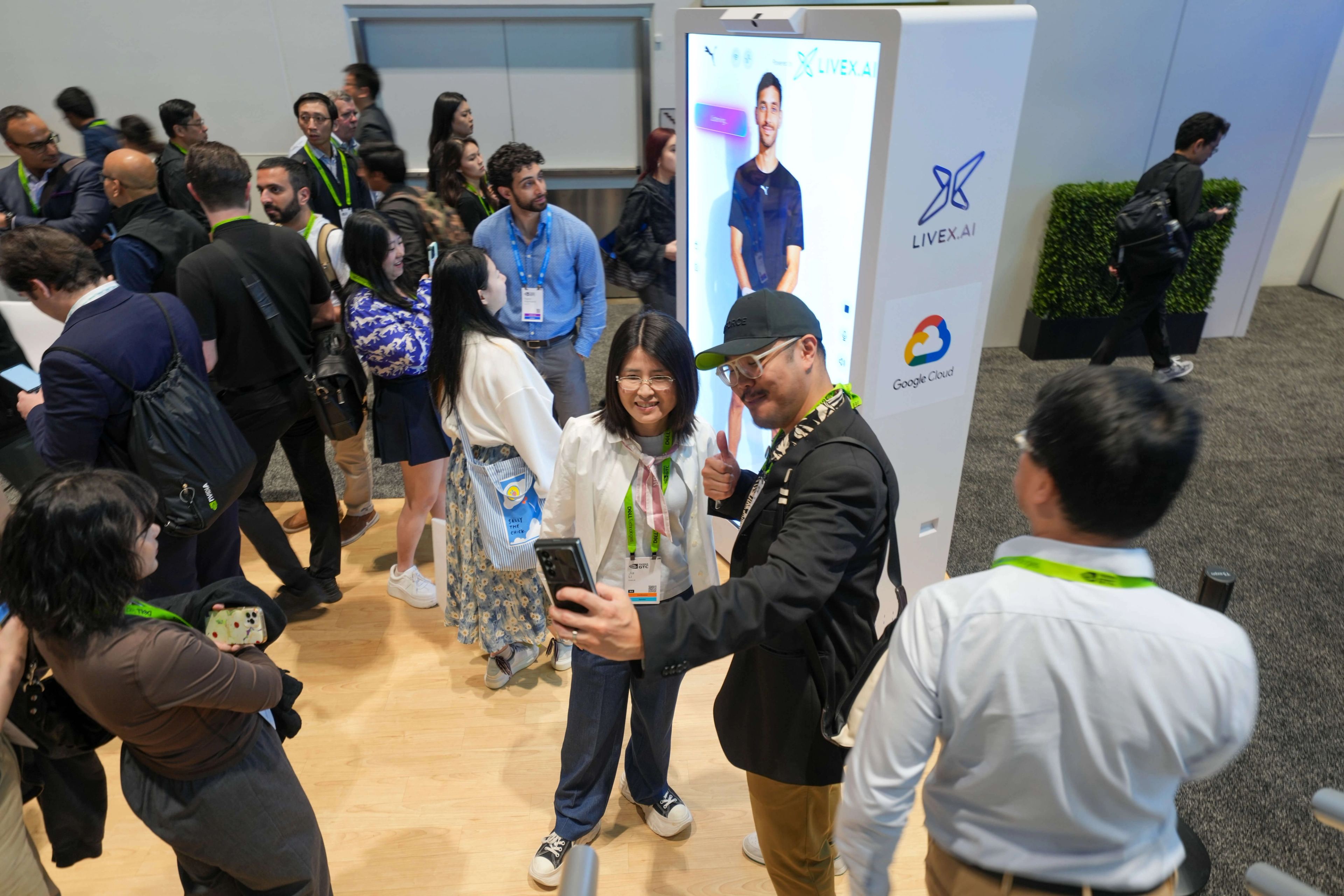
The LiveX Tower device was placed in the high foot-traffic center thoroughfare of San Pedro Square, allowing it to delight over 22,000 fans with one-of-a-kind NVIDIA & Google Cloud themed selfie images.
When the World Cup came to San Jose, LiveX AI deployed Lyra across a corridor that mirrored the fan journey itself: from airport arrival to downtown fan zones to hotel lobbies near the stadium. At San Pedro Square — the city's central fan zone — LiveX partnered with SJ26, the official San José host committee, to bring Lyra to the heart of the celebration. Installations also went live in the lobbies of the Marriott San Jose, the Signia by Hilton San Jose, and the Hotel De Anza. A separate deployment at the Hilton Santa Clara, the hotel positioned immediately outside Levi's Stadium, extended the activation to the stadium's front door, where delegates and guests gathered on match days.
The brief was straightforward: give fans from around the world a way to engage with the tournament in their own language, capture a branded selfie moment, and carry it home. Lyra handled soccer-themed conversations, offered intuitive wayfinding around the festivities, and powered custom selfie experiences — all in 140-plus languages, with approximately two-second response times.
For the host committee, the activation did more than serve fans; it helped tell the city's own story:
"We were thrilled to partner with LiveX AI for SJ26. Their AI holograms provided intuitive wayfinding and helped showcase San José as the capital of AI. Thank you for making this groundbreaking fan experience happen."
Tommy OHare
Director of Sports & Special Events, City of San Jose
The fan zone carried the majority of traffic, but the hotel lobbies proved just as significant — together, the venues formed a network that met fans at every step from arrival to kickoff. Keeping that network running flawlessly for 39 straight days, across five locations, in 140-plus languages, is its own achievement — and the results it produced redefine what a branded physical experience can deliver.
The Numbers
Over 39 days, Lyra drew more than 7,000 guest sessions and captured over 6,300 branded selfies — meaning nearly 9 in 10 guests who engaged walked away with a branded photo. More than 8 in 10 went a step further, scanning a QR code to retrieve the photo on their own phone — carrying the experience, and the sponsor brands, home with them. Guests rated the experience 4.7 out of 5.
The reach multiplied from there. Because fans took selfies in groups, more than 22,000 people appeared in frame across the branded photos. Every selfie was co-branded with Google Cloud and NVIDIA, and every one that was saved or shared carried those brands into a camera roll, a group chat, a social feed — earning the partners organic reach that money can't buy, because guests chose to share it.
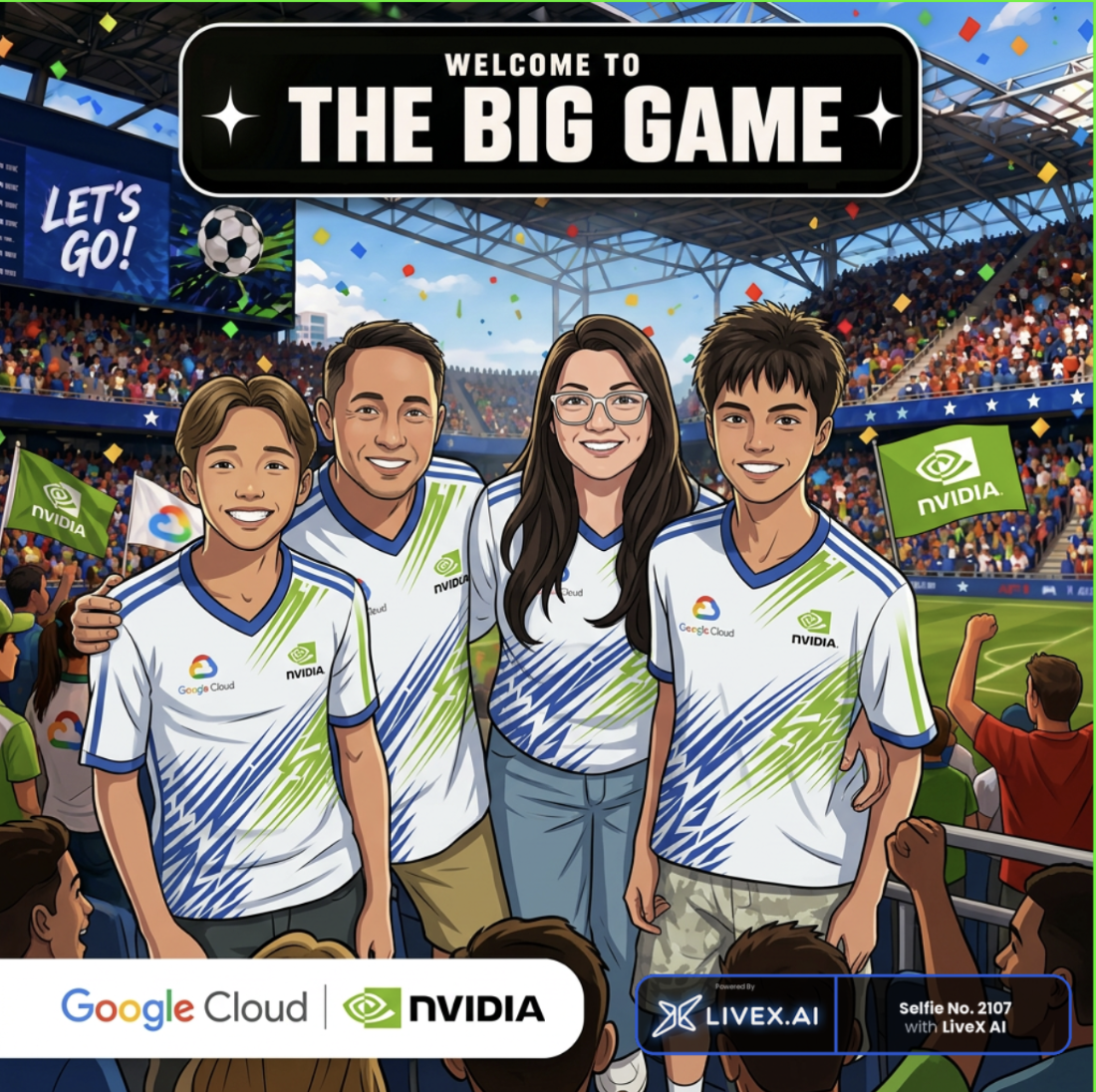
Each custom LiveX selfie featured soccer themes with NVIDIA and Google Cloud branding. Up to 12 people at once could participate in each selfie, making it a fun and inclusive experience for families and groups alike.
Add the foot traffic, and the footprint grows by another order of magnitude: an estimated 200,000-plus passive impressions at the fan zone alone, against the one million fans reported attending watch parties in downtown San Jose.
One activation. Three layers of reach: thousands of deep, voluntary engagements; tens of thousands of branded photo impressions; hundreds of thousands of passive views. But the number that matters most is not any single figure — it is the conversion between them. That nearly 9 in 10 engaged guests took a photo, and more than 8 in 10 pulled it onto their own phones, is the post-interaction layer made visible: attention did not evaporate when the guest stepped away from the screen: it converted into an action the venue and its sponsors could measure and keep.
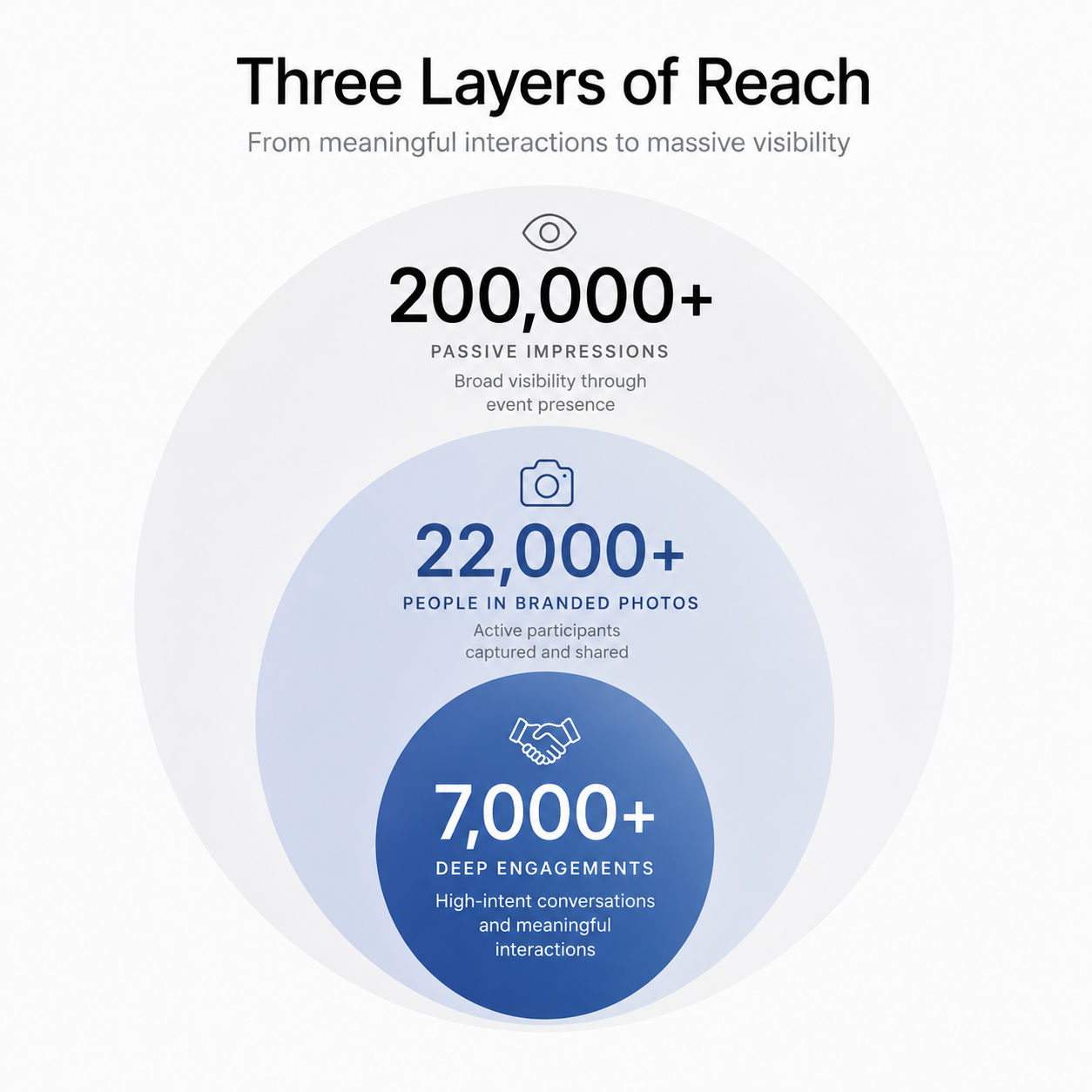
One LiveX device delivers three levels of sponsorship value. Top of funnel: passive impressions from every passerby. Mid-funnel: active, branded interactions. Bottom of funnel: full conversations that educate and convert users.
Marriott San Jose: A Case Study in Three Revenue Layers
The Marriott San Jose deployment is the clearest proof of the stunt-to-infrastructure shift, because nothing about it was temporary. It illustrates the full commercial model for physical AI in hospitality — not as a cost center, but as infrastructure that pays for itself through three distinct value streams.
The LiveX installation was originally placed in the Marriott San Jose lobby as a concierge for NVIDIA GTC 2026. It was never removed. When the World Cup arrived, the same installation transitioned seamlessly from conference concierge to fan-engagement platform, then continued serving as a permanent guest-experience asset. Its general manager describes the arc — and the three distinct value streams it now delivers — in a single breath:
"We brought it in as a concierge for GTC and never took it out. Guests use it in their own language without waiting for the front desk, our corporate partners have paid to be on the screen, and it has become one of the easier ways we sign people up for Bonvoy."
James Fridman
サンノゼ マリオット ゼネラルマネージャー
Those three uses — concierge, sponsored screen, and loyalty sign-up — map directly to three revenue layers.
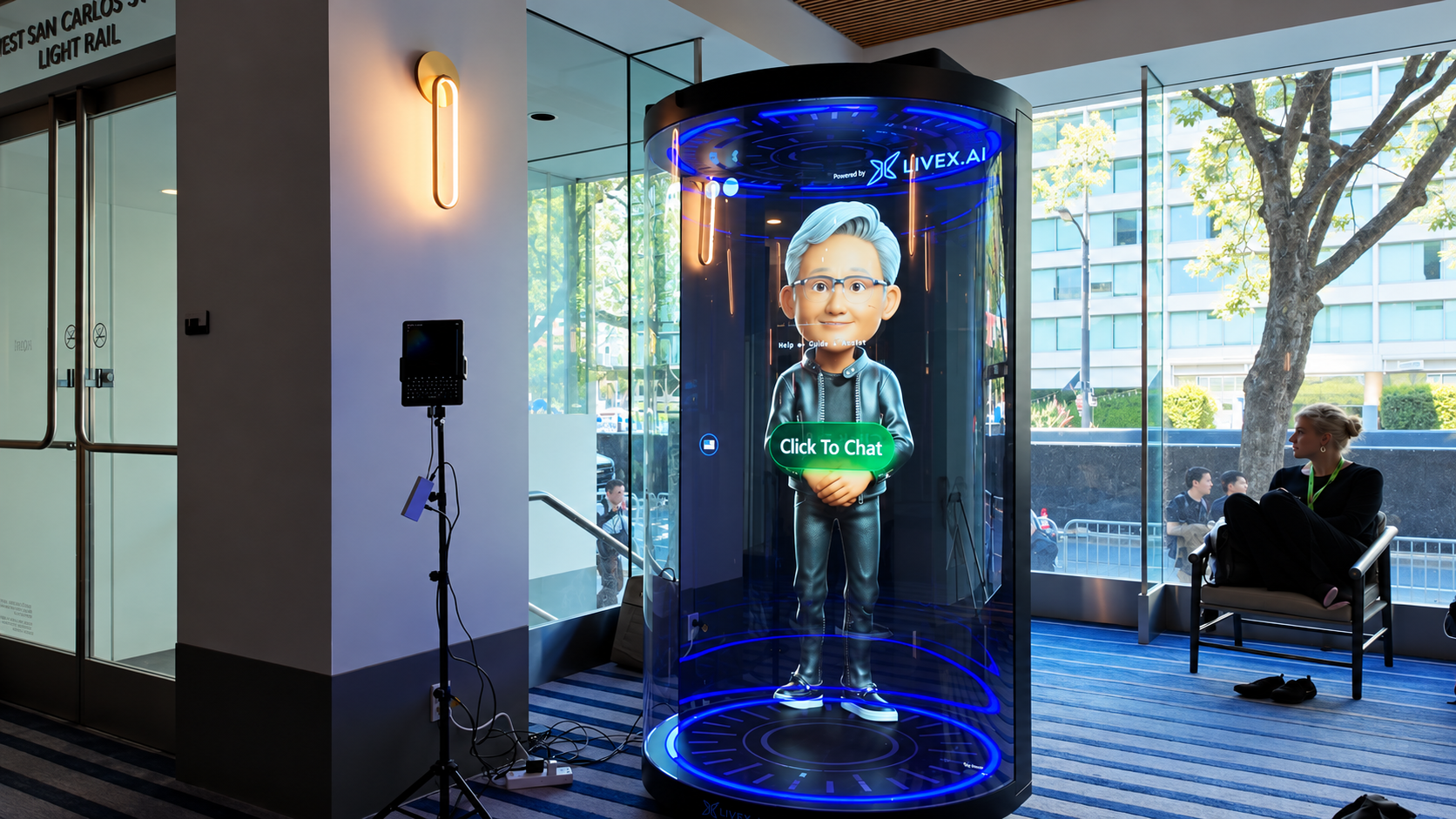
The LiveX Tower device placed in the hotel lobby greeted visitors with a custom themed AI avatar featuring NVIDIA and Google Cloud branding.
Revenue Layer 1: Sponsored Activations
The co-branded selfie experience ran across every venue, but the Marriott lobby added something the fan zone could not: a sponsorship transaction. Google Cloud and NVIDIA — the same partners powering the platform — chose to put their brands on the lobby screen during the World Cup, reaching international guests at a moment of genuine delight rather than through another banner or booth. That two of the world's leading technology companies saw the value in this surface is itself a signal: the hotel lobby had become an engagement channel worth investing in.
This is a fundamentally new revenue line for hotels. The lobby has always been high-traffic real estate during major events, but it has never been monetizable in a structured way. With the LiveX rental and revenue-share model, the hotel's downside is capped while upside scales with event calendar density. For a property like the San Jose Marriott — which hosts guests during GTC, the World Cup, and dozens of other Silicon Valley conferences each year — the event calendar itself becomes a media asset.
Revenue Layer 2: Loyalty Acquisition
Warming up towards the World Cup, Marriott ran its own Bonvoy World Cup selfie experience, extending the FIFA partnership guests already recognized. The selfie moment doubled as an on-ramp into Marriott Bonvoy, and roughly 1 in 10 participating guests signed up on the spot. That's the hardest part of loyalty acquisition — catching someone in a genuinely fun moment — made repeatable.
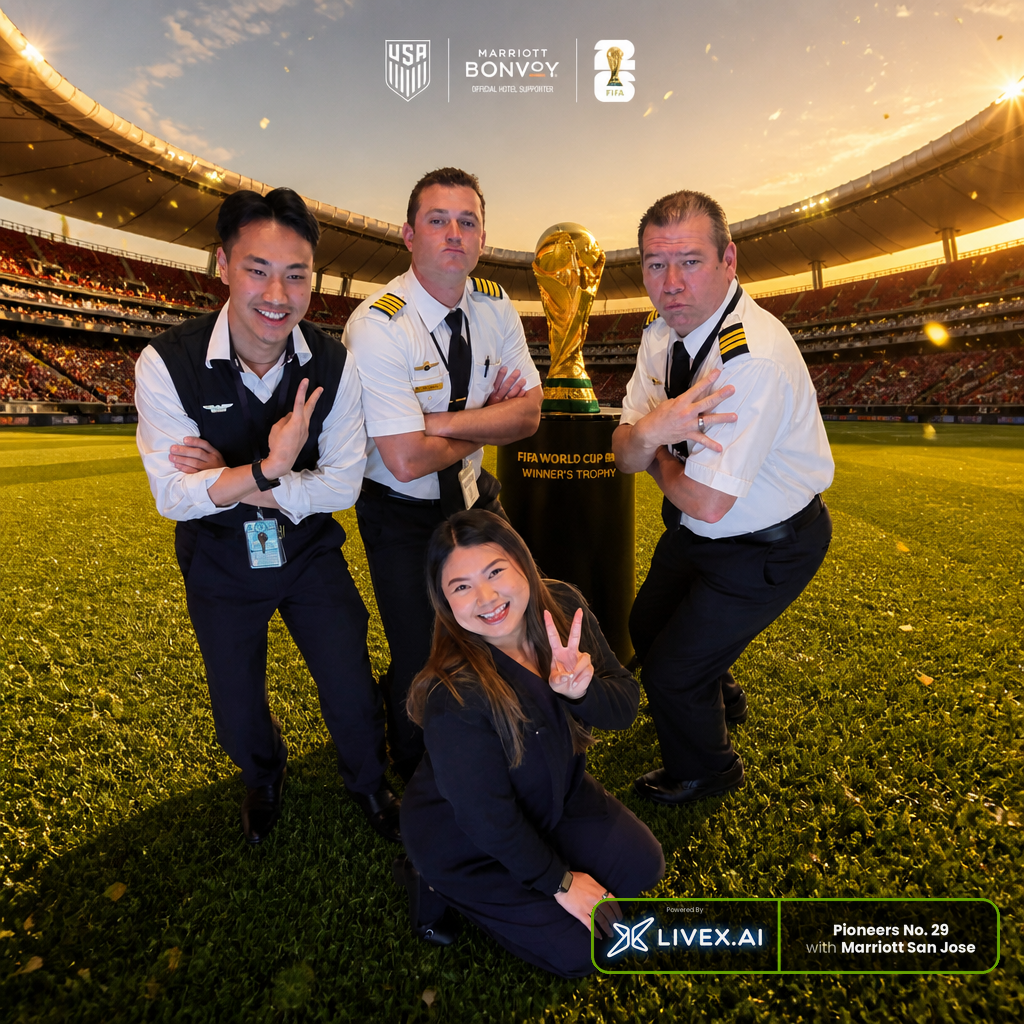
The Bonvoy World Cup selfie, co-branded with Marriott Bonvoy and FIFA and captured right in the lobby. Guests kept the image with the option to post to socials, with the loyalty sign-up happening in the same interaction.
A double-digit conversion rate is remarkable for any loyalty channel. Traditional sign-up mechanisms — front desk prompts, in-app pop-ups, email campaigns — compete for attention in neutral or transactional moments and typically convert a small fraction of that. Members acquired this way also start their relationship with the program attached to a positive memory, not a checkout box.
For any hotel brand running the math on loyalty acquisition cost, the comparison is instructive: the per-member cost of a selfie-driven sign-up versus the per-member cost of paid digital acquisition, direct mail, or front desk conversion programs.
Revenue Layer 3: Concierge Efficiency
On peak travel days, the Marriott installation handled a guest interaction every few minutes, all day long — engagement that would have otherwise required front desk staff time. Over the full World Cup window, the device served well over a thousand sessions in languages ranging from Spanish and Portuguese to Mandarin, Arabic, French, and Japanese, with roughly two-second response times and no queuing.
For hotels hosting guests from around the world, language is central to hospitality — and during a global event, no front desk can staff every language at once. Lyra gave the Marriott's team a partner that could greet every guest in their own language, at any hour, so the staff could spend their time on the moments where human warmth matters most. It is not a replacement for great service; it is a way to extend it to everyone, in every language, without anyone waiting.
The Model Travels
The San Jose deployment became the template. The same playbook — everyday concierge, sponsored activations during events, loyalty capture — is now running at the San Francisco Marriott Marquis, one of the largest hotels on the West Coast. What proved out in one lobby is being installed as standard equipment in the next, and the properties adopting it are flagships, not test sites.
For any property with a busy event calendar, the economics are straightforward. Every conference, tournament, or peak travel weekend already drives a surge of guests through the lobby. The same installation that answers their questions in their own language can carry a sponsor's brand during the event and convert loyalty enrollments in the moment — one asset doing three jobs, against an event calendar the property already has.
For a deeper dive on LiveX’s Marriott deployment, you can check out the full case study ここに.
Hilton Santa Clara: The Stadium's Front Door
The Hilton Santa Clara occupies a unique position in the World Cup geography: it sits immediately outside Levi's Stadium, making it the gathering point for delegates, VIPs, and fans on match days. The hotel hosted "The End Zone," a tailgate celebration where fans in national colors gathered before kickoff.
LiveX deployed Lyra at the Hilton Santa Clara to greet guests arriving for the biggest moments of the tournament — extending the same multilingual, selfie-enabled fan experience from downtown San Jose all the way to the stadium doorstep. On match days, the hotel became a natural refuge from the summer heat: travelers, fans, and families with kids and friends stepped inside to cool off before and during the games, and Lyra turned that downtime into moments of delight — conversations, selfies, and shared laughs in comfortable air-conditioned space, steps from the stadium gates.
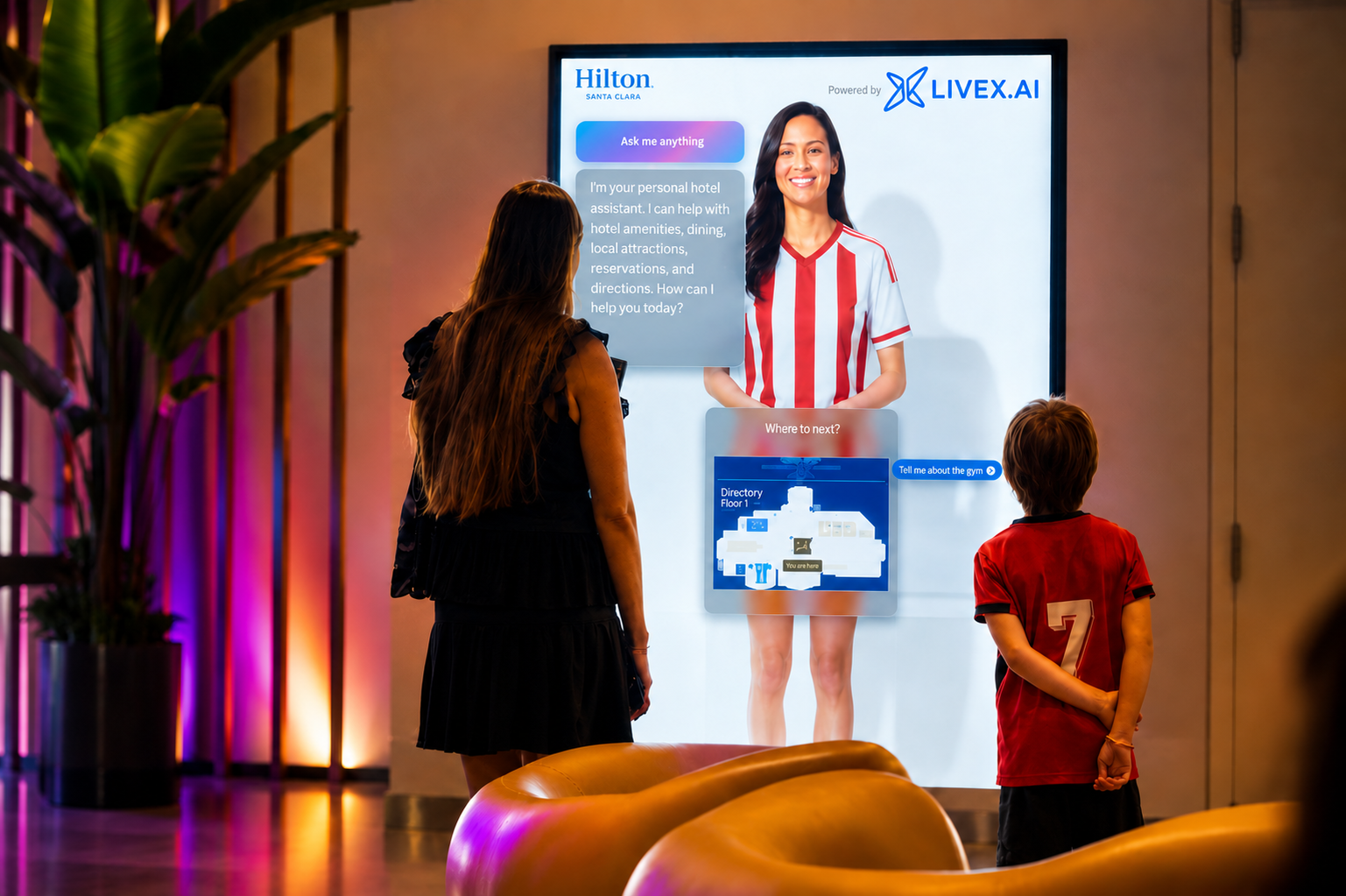
Hilton guests from all over the world loved engaging with our LiveX Gateway. When the Paraguay team came to the property for their tail-gate party, we deployed a custom AI avatar with the Paraguay jersey, meeting the moment and adding to the excitement.
What began as a guest-experience enhancement quickly became something larger. The same platform that welcomed fans during the tournament had first been introduced during a major property renovation, and it has since evolved into a channel that generates value for the hotel's corporate partners — the same arc the Marriott deployment followed, in the words of the hotel's own leadership:
"In a remarkably short period of time, this technology has become a strategic asset within our operation — enhancing the guest experience, serving as a central feature during our World Cup activations, and evolving into a platform that creates new value for corporate partners. Its impact extends well beyond innovation, contributing to both guest engagement and revenue growth."
ファルシャド・マエルザデ
General Manager, Hilton Santa Clara
Combined with the Signia by Hilton San Jose deployment downtown, where guests engaged with Lyra hundreds of times over the tournament window, the Hilton brand had venue AI coverage across both the city center and the venue perimeter. It is a fitting expression of what hospitality has always been about — making every guest feel welcome — now extended to fans from dozens of countries, in dozens of languages, at one of the most memorable moments of their trip. Hilton did not treat physical AI as an experiment to be tolerated; the team embraced it as a natural extension of the welcome their brand is built on.
For a deeper dive on LiveX’s Hilton deployment, you can check out the full case study ここに.
NBA Summer League: Turning Fans into Designers
Multiple LiveX gateways helped turn the Summer League stadium concourse into an interactive basketball culture and merchandise experience.
While the World Cup was still underway in the Bay Area, LiveX opened a second front in Las Vegas — and the timing could not have been better. The 2026 NBA Summer League was the biggest in the event's history: more than 156,000 fans attended over eleven days, breaking the previous attendance record by 12 percent, while the championship game drew the largest television audience since 2017. Merchandise sales set an all-time high. What was once a scouting showcase for rookies and basketball diehards has become one of the marquee events on the sports calendar — packed arenas, national broadcasts, and serious retail demand.
Into that environment, LiveX brought an entirely different use case — a pivot from hospitality concierge and fan greeting to interactive retail. The NBA's brief was specific: Summer League retail should feel less like browsing a table of pre-made shirts and more like a personalized moment fans actually want to be part of.
The result was The Paint Shop, an interactive fashion workshop on the Thomas & Mack Center concourse. Fans walked up to a seven-foot LiveX device, engaged a life-sized AI agent, selected their team, chose logos and patches, and watched a custom hoodie appear on themselves in real time through AI-powered try-on. From design to purchase, the entire flow happened at the device: fans picked their size, scanned a QR code, and completed the transaction on their phone — no checkout line, no fitting room, no staff required for the transaction itself.
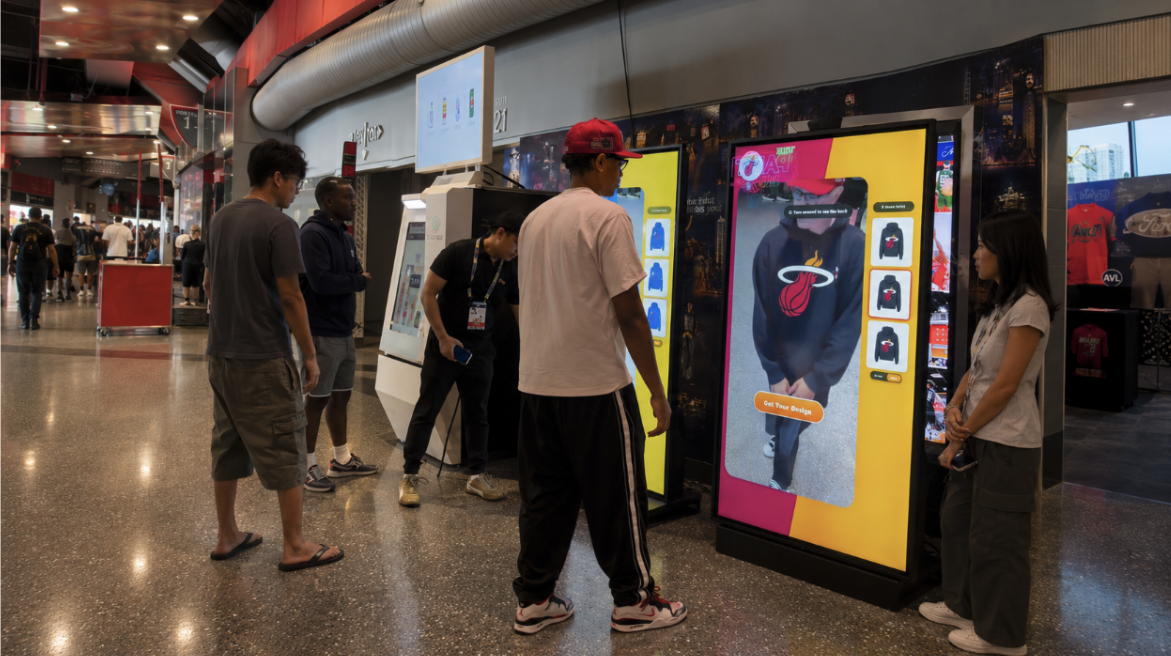
One major friction for merch sales at major events is the added complexity that dressing rooms introduce. With LiveX’s virtual try on experience, fans can see how they look in any branded merchandise within seconds, accelerating time to purchase and offering a one-of-a-kind apparel experience.
This is the post-interaction layer in its most direct form. At the World Cup, the layer converted attention into a saved photo and a loyalty sign-up; on the Summer League concourse, it converted attention into a completed purchase. But for the fan, it was something simpler and better: a chance to make something their own. The hoodie a fan designed at The Paint Shop is not the shirt everyone else is wearing — it is theirs, chosen and created in the moment, a keepsake from a day they will remember. Every fan who designed one could also capture a selfie and share it, and every interaction generated data — design choices, size preferences, team affinities — giving brands the ecommerce-quality analytics traditionally confined to online retail. The fan gets a story to tell; the brand gets to understand its fans better than a merchandise table ever could.
For the NBA and its merchandise partners, the activation introduced a new model for in-venue retail: physical AI as a bridge between the impulse of being at the game and the conversion mechanics of online commerce, without the friction of either. The same principle applies wherever a venue moves merchandise — arenas, festivals, theme parks, flagship stores. It already runs at PUMA's Las Vegas flagship, where the same LiveX platform powers an in-store AI concierge, Dylan, that greets shoppers in over 100 languages and connects them to live inventory — the retail use case proven not for the length of an event, but as simply how the store works now.
Like the hotels, the NBA is looking forward. For a league whose business is the fan relationship, physical AI is a way to make that relationship deeper and more personal at scale: better growth, in new revenue captured at the peak of game-day excitement; unforgettable fan experiences, in moments a fan designs, keeps, and shares rather than merchandise they simply buy; and stronger fan loyalty, built through interactions that feel made for each person. The most fan-obsessed organizations in sports are treating physical AI not as a gadget on the concourse, but as a new way to show up for the people who love the game.
For a deeper dive on LiveX’s NBA deployment, you can check out the full case study ここに.
The Tech Stack: Human-Like AI at Live-Event Speed
Every deployment described above — fan zones, hotel lobbies, arena concourses — ran on the same underlying infrastructure, engineered by LiveX AI together with NVIDIA and Google Cloud. This was not an off-the-shelf integration; it was a genuine collaboration, with all three teams solving the hard problems of real-time, multimodal, multilingual AI in unpredictable physical environments. That consistency is the foundation of repeatability: LiveX does not rebuild the stack for each activation. The same platform scales from a single hotel lobby to a multi-venue, multi-city sports deployment.
The NVIDIA layer. The stack runs on open NVIDIA ネモトロン models handling core language understanding and generation. NVIDIA NIM マイクロサービス provide containerized, optimized model serving. By deploying a Mixture of Experts architecture on NIM containers running on Google Kubernetes Engine, LiveX achieved 6.1x faster response generation compared to alternative inference platforms — a critical advantage when a fan is standing in front of the device and every second of latency erodes the experience.
For deployments with strict data residency or privacy requirements, on-premises NVIDIA Nemotron instances keep inference local. The retrieval layer uses NVIDIA Nemotron Embed and Rerank models, packaged as NVIDIA NIM microservices, to ground responses in domain-specific knowledge — venue maps, event schedules, hotel information, merchandise catalogs — reducing hallucinations and improving contextual accuracy across location-specific queries. The stack is accelerated by NVIDIA RTX PRO 6000 Blackwell Server Edition providing the throughput and memory bandwidth needed to sustain concurrent multimodal inference at the latency targets live environments demand.
LiveX AI is a member of NVIDIA インセプション, a global program for AI startups that provides developer training and resources, valuable offers from NVIDIA and our partners, and preferred access to NVIDIA’s AI ecosystem.
The Google Cloud layer. As detailed in a joint technical post with Google Cloud, LiveX's architecture is intelligently layered across Google Cloud services to optimize for performance, scalability, and cost-efficiency. Cloud Run powers the front-end and orchestration layers, automatically scaling from zero to thousands of instances during traffic spikes — the exact pattern live events produce — then scaling back down. Google Kubernetes Engine handles AI inference, with cluster autoscaling that dynamically provisions GPU node pools only when needed and intelligent load balancing for real-time responses.
At the heart of the platform sits AgentFlow, LiveX's orchestration engine, which manages conversational state, interprets intent, coordinates knowledge retrieval, and connects to external systems — so the same architecture that answers a fan's question in a hotel lobby can process a hoodie purchase on an arena concourse. The knowledge layer combines a Retrieval-Augmented Generation system with Cloud SQL for long-term storage and Memorystore for short-term context, keeping every response grounded and current.
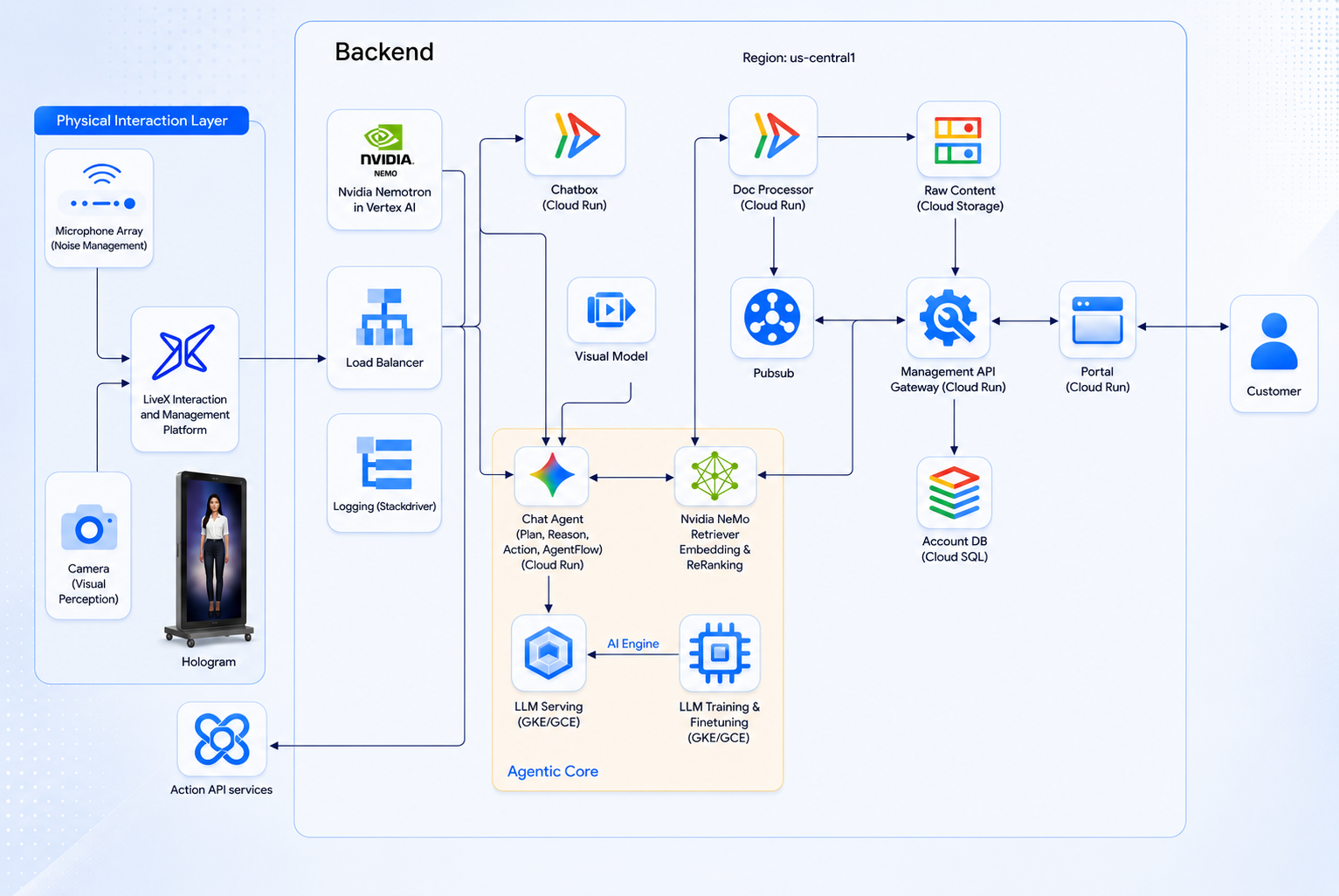
Architecture diagram: the Human Like AI Interaction Tech stack.
This foundation allows LiveX to serve massive concurrent demand while maintaining sub-second response times in over 100 languages — and it is the same architecture that has delivered a 90-plus percent self-service rate for smart home leader Wyze and a 3x conversion increase for video platform Pictory. The infrastructure proven in enterprise customer service is the infrastructure deployed at the World Cup and NBA Summer League.
The implication for venues, brands, and sponsors is straightforward: this is production infrastructure, not a prototype. The same platform ran nonstop for 39 days across multiple World Cup venues, then simultaneously powered real-time AI try-on and commerce at NBA Summer League in another city — two global sporting events, two entirely different use cases, one architecture, without missing a beat. That reliability is a shared achievement: NVIDIA's accelerated computing and open models, Google Cloud's elastic infrastructure, and LiveX's orchestration and physical-world deployment expertise, engineered into a single system that performs when thousands of people are watching.
More than a technical collaboration, it reflects a shared conviction. NVIDIA and Google Cloud are not backing a one-off activation; they are enabling physical AI as a category — the belief that human-like agents will increasingly live in the spaces around us, greeting fans, guiding travelers, and serving customers in the real world, not just on a screen. The fan interactions of summer 2026 are an early, visible proof of that future. The partnership exists to build the rest of it.
The ROI Framework: Who Benefits and How
The earlier sections showed the returns venue by venue; taken together, they resolve into a clear picture of who gains what.
Venues and hotels capture three returns from a single installation, as both general managers described first-hand: operational efficiency (guests served in their own language without queuing at the front desk), sponsored revenue (corporate partners paying to appear on the screen), and loyalty conversion (the 1-in-10 Bonvoy sign-up rate, achieved in a moment of enjoyment rather than a transactional prompt). The rental and revenue-share model caps the venue's downside while the upside scales with event calendar density — and the return has proven repeatable, evolving from guest amenity to revenue asset within a single season and already replicating from one property to the next.
Sponsors get something traditional event sponsorship cannot deliver: interactive, measurable engagement where the guest voluntarily carries the brand home. A logo on a banner is a passive impression. A co-branded selfie that a guest designs, retrieves via QR, keeps in their camera roll, and shares with friends is four voluntary touchpoints in a positive emotional context. With nearly 9 in 10 guests engaging and more than 8 in 10 pulling the branded photo onto their own phones, the relevant benchmark shifts from cost-per-passive-impression to cost-per-engaged-session — where the LiveX model delivers data-rich engagement at a fraction of the cost per meaningful touchpoint.
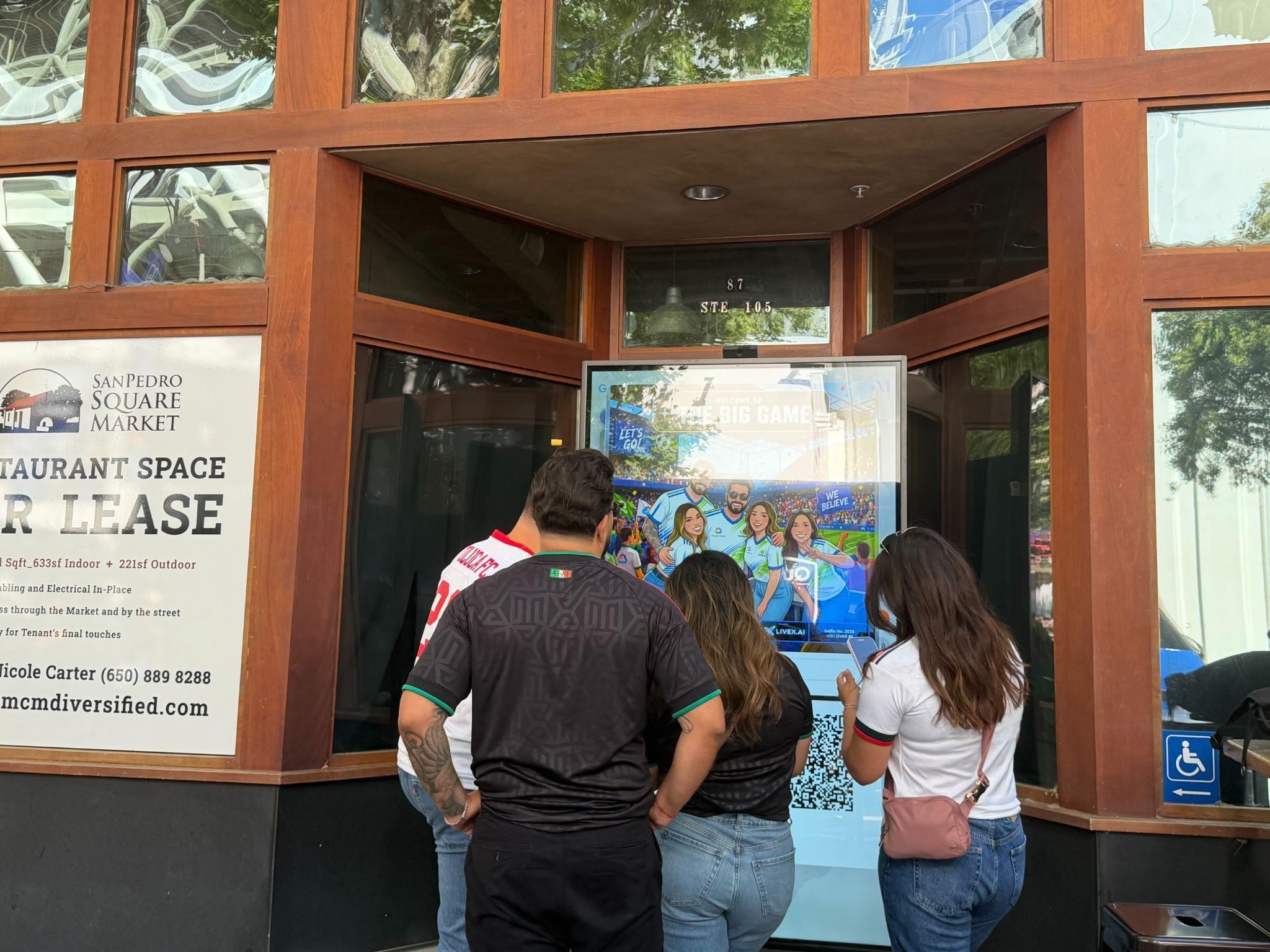
Fans enjoy the LiveX AI group selfie experience during the World Cup festivities at San Pedro Square Fan Zone.
The physical AI market in hospitality, retail and sports gets proof of something bigger than any single deployment: a single platform operating across multiple venues, multiple sports, multiple use cases, and multiple business models — concurrently, at production quality, for weeks at a time. When nearly 9 in 10 guests choose to interact and a 4.7-out-of-5 rating holds across thousands of interactions and dozens of languages, physical AI stops being a novelty people walk past and becomes the default behavior of a crowd. The question is no longer whether it delivers value in real-world environments. It is how quickly venues, brands, and sponsors make it permanent infrastructure — as the Marriott San Jose already has.
次に何が起こるのか
The playbook is proven, and the installations did not come down when the tournament did. The Marriott San Jose and the Hilton Santa Clara remain live, still serving guests and generating value months after the World Cup ended. The same model is now rolling out to flagship properties beyond San Jose — including the San Francisco Marriott Marquis, one of the largest hotels on the West Coast — while the NBA Summer League activation established a parallel model for in-venue retail. In every case, the same pattern held: a space a venue already operates became a source of guest engagement, sponsored revenue, and loyalty growth — measured, repeatable, and still running.
That pattern is not specific to sports, or to hotels, or to any one summer. Anywhere people gather in person — a hotel lobby, an airport terminal, a stadium concourse, a retail floor, a conference hall — the same mechanism applies: a physical AI interaction engineered so that the moment of attention converts into a measurable, ownable action. That is the post-interaction layer, and it is what separates infrastructure from novelty. A stunt ends when the crowd disperses. Infrastructure keeps producing — a saved photo, a new loyalty member, a completed sale, a dataset that compounds — long after the event is over.
What summer 2026 demonstrated is that the open question about physical AI in these spaces is no longer whether it delivers value in real-world environments. That has been answered — across multiple cities and two very different sports, by operators who chose to keep what they installed. What remains is how widely, and how quickly, the businesses that run those environments treat it the way the Marriott and the Hilton already have: not as a moment, but as equipment.
For the hotels, this is not merely a technology decision — it is a choice to embrace the future of physical AI on behalf of their guests. A better guest experience, in service that greets every visitor in their own language, at any hour, without a wait. Better operations, as the front desk is freed to focus on the moments where human care matters most. And better growth, in the new revenue and loyalty that the same installation generates. The properties that moved first are not experimenting; they are building the hospitality of the next decade, now.
This summer builds on a track record that began on the biggest stage of all — LiveX's first fan deployment came during Super Bowl week — and it points toward a future far larger than any single event. Built by LiveX AI with NVIDIA and Google Cloud, and embraced by forward-looking hospitality and sports leaders, these deployments point toward a near future in which human-like AI lives in the physical world around us — in the venues we visit, the stores we shop, and the places we gather. That is the future these partners are building toward, one crowd at a time.
LiveX AI builds human-like AI agents that see, hear, chat, and show — connecting the physical-world experience to the digital one. From holograms and kiosks in venues, hotels, stores, and live events, LiveX turns every in-person moment into lasting engagement at scale. Learn more at livex.ai.